
Rental bonds in WA: four weeks, a $350 pet bond, and why bond replacement products are illegal here
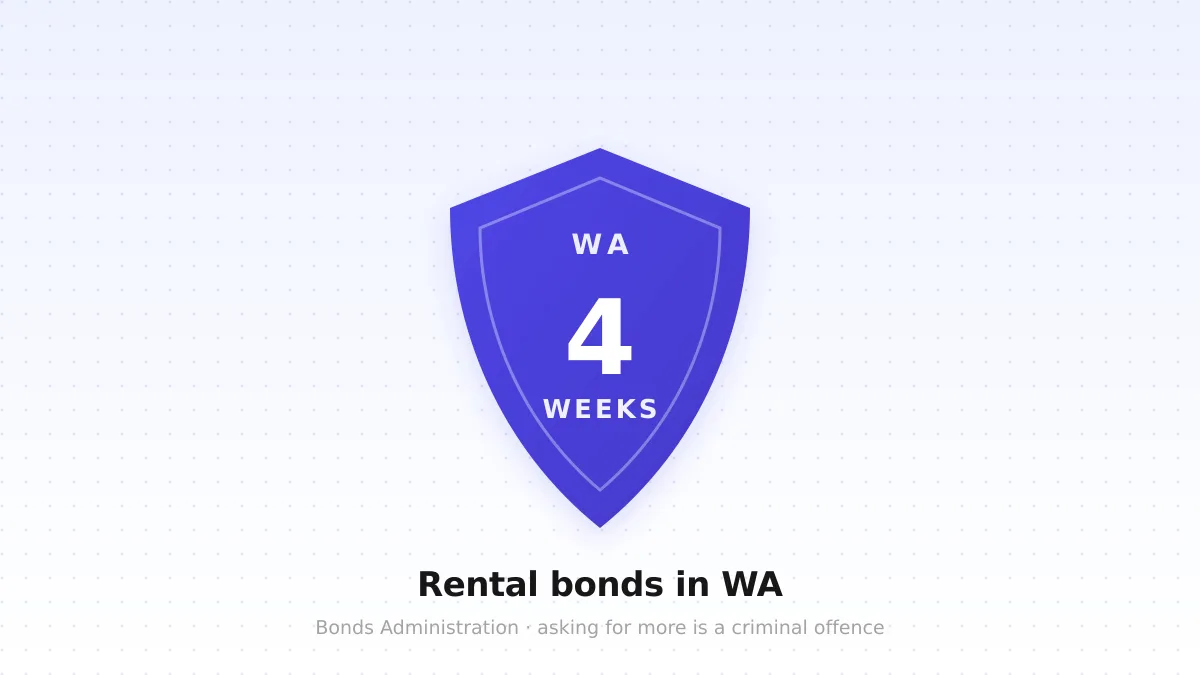
Asking for more than four weeks’ bond in Western Australia is a criminal offence, not a technicality. WA also publishes the clearest share-house lodgement rules in the country — and has banned the "bond alternative" products advertised elsewhere.
Western Australia sets out bonds in more detail than most states, including the bit other authorities leave vague: exactly how a bond is supposed to work when several people share one house.
The numbers
| What | Maximum in WA |
|---|---|
| Rental bond | 4 weeks’ rent, where rent is $1,200 a week or less |
| Rent in advance | 2 weeks |
| Pet bond — residential tenancy | Up to $350, for fumigation and pet-related damage |
| Pet bond — residential park | Up to $250, for fumigation only |
Asking a tenant for more than four weeks’ rent as a bond is a criminal offence in Western Australia. It is not a grey area you negotiate over.
Your bond can be topped up during the tenancy if the rent goes up, and an existing pet bond can only be increased at the next rent increase or when an additional pet is approved.
Who holds it
Bonds must be lodged with Bonds Administration within 14 days of being paid. Everyone named on the bond gets a record sent to them directly once the payment lands, which is a useful design: you do not have to ask anyone whether your money arrived.
You must also be given a receipt immediately on payment. A receipt from a private landlord has to show the date, the tenant names, the amount, any pet bond, and the address. A receipt from an agent has to be headed "Trust Account Receipt" and carry the agency and receipt number. A handwritten scrap with a number on it does not meet the standard.
Share houses: WA spells this out
Co-tenancy — one agreement, several people
Every tenant’s name should appear on the bond lodgement form. This is not a formality: it is what protects each person’s share, and it is what lets you claim your portion when you leave. If your name is not on the bond record, you are relying on your housemates to hand your money back.
When somebody moves in or out, the bond is changed using a bond variation form. Settle who owes what before anyone signs it, because the remaining housemates may also need to top the bond up.
Subletting — several agreements, one house
If you are a sub-tenant paying a bond, the head-tenant must lodge it with Bonds Administration, listing you as the tenant and themselves as the landlord. Where each person has their own agreement, each bond is lodged separately. So there is a correct answer to "where has my money gone", and you are entitled to it.
Bond replacement products are illegal in WA
You may see schemes advertised as a cheaper alternative to a bond: you pay a company a recurring fee and they guarantee an amount to the landlord instead. These are illegal in Western Australia, and it is worth understanding why, because they are marketed elsewhere.
The fee is not refundable, unlike a bond. Renewal fees can rise until you have paid more than the bond would have cost. And if the landlord’s claim exceeds the guaranteed amount, you still owe the difference — the company can pay out and then come after you for it. You get the cost of a bond without the protection of one.
Consumer Protection asks that you report anyone selling these on 1300 30 40 54.
Getting it back
Property condition reports are the evidence that decides bond claims in WA, and landlords must give you two copies before you move in. Complete your copy honestly and in detail, photograph what you describe, and return it on time.
The bond is released when Bonds Administration receives either written agreement from everyone on a bond release form, a Commissioner’s decision, or a court or tribunal order. If you cannot reach agreement, Consumer Protection handles bond disputes for residential tenancies.
If you cannot raise the bond in the first place, the Department of Communities runs a bond assistance loan — the bond is still lodged in your name and works like any other, and you repay the loan at the end of the tenancy.
Where these numbers come from
Every figure on this page was read off the official source below on 15 August 2026. Tenancy rules change — sometimes more than once a year — so if you are about to hand over money, spend two minutes confirming against the original.
- Consumer Protection WA — Rental bonds
- Consumer Protection WA — Bond disputes for residential tenancies
- Consumer Protection WA — Renting with pets
- Department of Communities — Bond assistance loans
This is general information to help you ask better questions, not legal advice. If something has already gone wrong, your state tenancy authority and your local tenants advice service will both help you for free.