
Rental bonds in Victoria: one month, the $900 cliff, and the rooming house trap
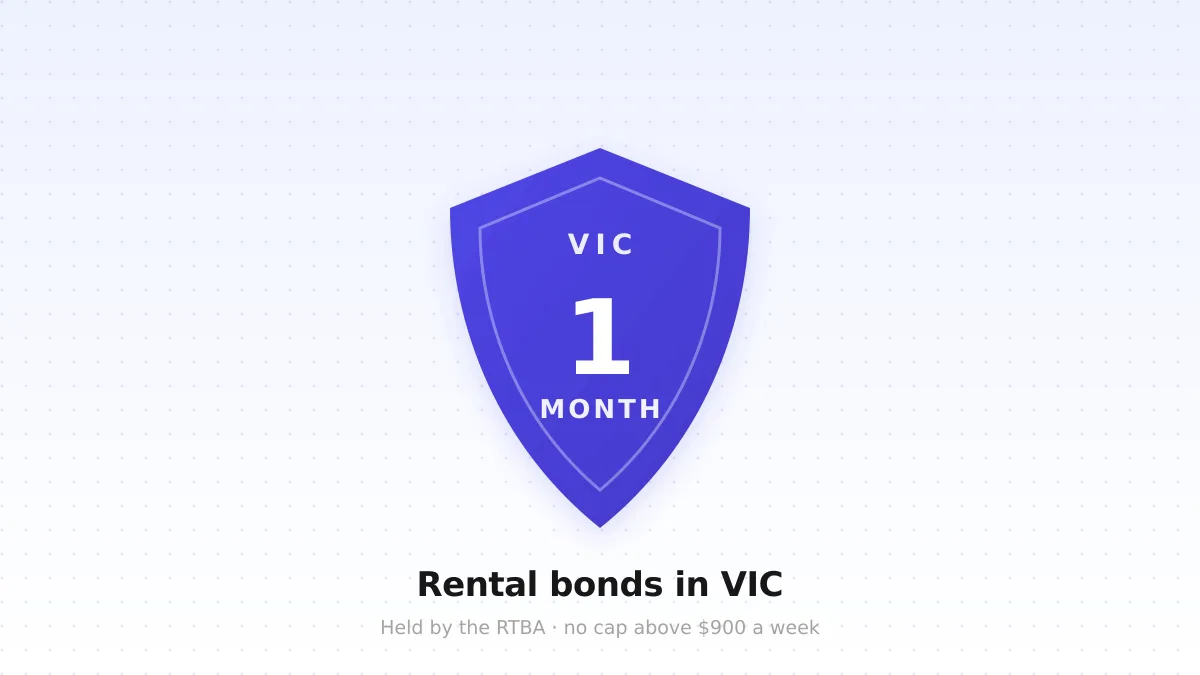
Victoria caps bonds at one month’s rent — but the cap vanishes entirely above $900 a week, and if four or more people can occupy rooms in your house it may legally be a rooming house with completely different bond rules.
Victoria’s bond rules are stricter than most of Australia in one respect and looser in another, and the difference between a share house and a rooming house — a distinction almost nobody moving in has heard of — changes the numbers again.
The numbers
| Situation | Maximum bond |
|---|---|
| Standard rental agreement | 1 month’s rent |
| Weekly rent above $900 | No cap. The limit simply does not apply. |
| Rooming house, fixed term | 28 days’ rent |
| Rooming house, not fixed term | 14 days’ rent |
VCAT can also approve a higher bond for a particular property because of its character or the quality of its furnishings, but that is a decision on the record, not something a landlord can assert.
One month is not the same as four weeks. A month is roughly 4.33 weeks, so on $300 a week the Victorian maximum is about $1,300 rather than $1,200. If you are comparing a Melbourne room to a Sydney one, budget for the difference.
Who holds it, and when
Bonds are held in trust by the Residential Tenancies Bond Authority (RTBA). If you pay the rental provider directly, they must lodge it with the RTBA within 14 days (not counting public holidays), and the RTBA must send you a receipt with your bond number within 7 days of receiving it.
If that receipt never arrives, your money is not where it should be. Chase it — an unlodged bond is the single most common way this goes wrong.
Victoria also runs a Portable Rental Bond Scheme, which lets eligible renters transfer an existing bond straight to the next property instead of finding a second lump sum while waiting for the first to come back. If you are moving between rentals, it is worth checking whether you qualify before you borrow money you do not need to borrow.
Share house or rooming house?
This is the distinction that catches people, and it is not about the vibe of the place — it is a legal test.
- A share house is one where everyone signs the same rental agreement.
- A rooming house is a property where four or more people can occupy the rooms, and each resident has an individual agreement with the operator.
If you are answering an ad for one room in a five-bedroom house and you are being asked to sign your own agreement covering only that room, you are probably looking at a rooming house — which means your bond is capped at 28 or 14 days’ rent rather than a month, and a different set of rights applies to you. Rooming houses must be registered with the local council. It is entirely reasonable to ask.
Sub-letting
If you are moving in under the existing renter rather than the owner, the head renter can ask you for a bond. Get the arrangement in writing and confirm it has been lodged.
If several of you are on one agreement
The RTBA takes the bond as a single lodgement, so only one person can physically pay it. Agree who pays and how everyone reimburses them before anyone transfers anything — this is a very common source of bad feeling later, and it is completely avoidable with one message in the group chat.
Extra bond during the tenancy
A rental provider can only ask for additional bond in two situations: a long-term agreement of more than five years, or where you have made changes to the property that they have agreed to remove at the end. Outside those, a mid-tenancy demand for more bond is not something you have to accept, and you can challenge it at VCAT — which will consider, among other things, whether paying it would cause you severe hardship.
Getting it back
Photograph everything before you unpack, and make sure you receive a condition report — the rental provider must complete one and give you a copy whenever a bond has been paid.
At the end, the bond is repaid once both sides agree how it should be split. Where they cannot agree, disputes go through Rental Dispute Resolution Victoria (RDRV) and on to VCAT. The bond is your money by default; the burden is on the person claiming a deduction to justify it.
Where these numbers come from
Every figure on this page was read off the official source below on 15 August 2026. Tenancy rules change — sometimes more than once a year — so if you are about to hand over money, spend two minutes confirming against the original.
- Consumer Affairs Victoria — Bond amounts and payments
- Consumer Affairs Victoria — Rooming house agreements
- Victorian Government — Portable Rental Bond Scheme
- Residential Tenancies Bond Authority (RTBA)
This is general information to help you ask better questions, not legal advice. If something has already gone wrong, your state tenancy authority and your local tenants advice service will both help you for free.