
Rental bonds in South Australia: the $800 line that decides whether you pay four weeks or six
South Australia is the only state where crossing a rent threshold makes your bond bigger rather than removing the cap. At $800 a week or less it is four weeks’ rent; above that, six.
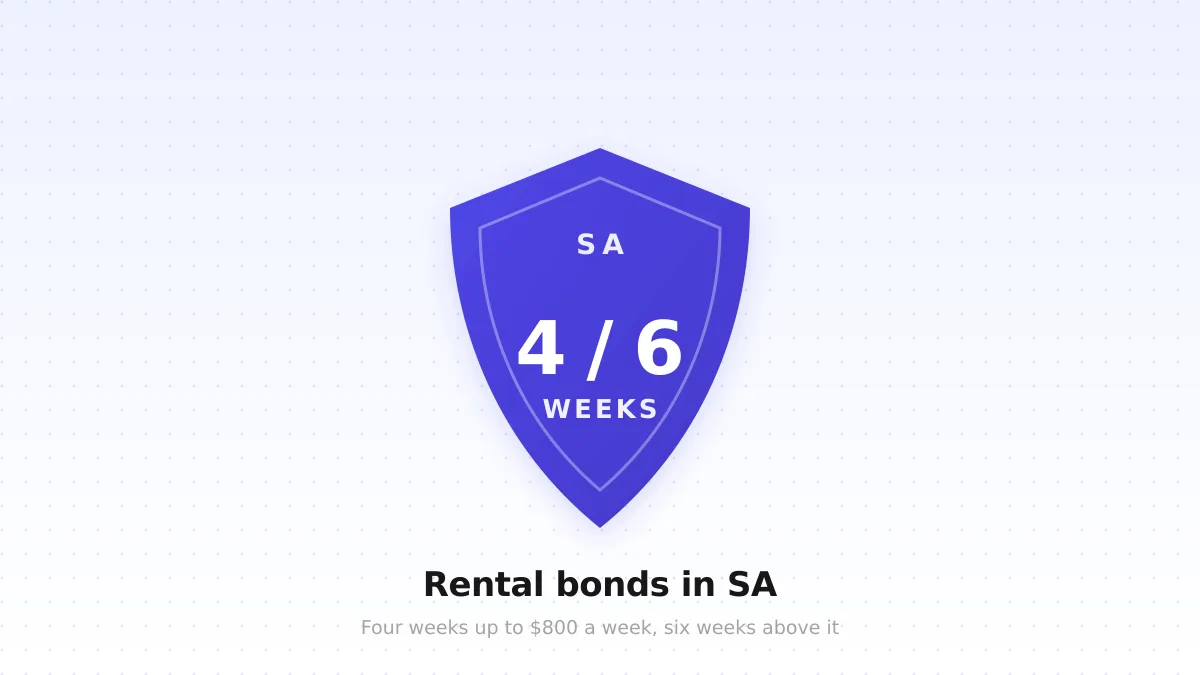
South Australia used to charge six weeks’ bond across the board. Since 1 April 2023 most renters pay four — but the old figure still applies above a rent threshold, and the threshold is low enough that plenty of Adelaide share houses sit near it.
The numbers
| Weekly rent | Maximum bond |
|---|---|
| $800 or less | 4 weeks’ rent |
| More than $800 | 6 weeks’ rent |
Note what this threshold does. In Victoria and WA, going over the line removes the cap; in South Australia it raises it by 50%. On $810 a week that is roughly $4,860 rather than $3,240 — a $1,620 difference triggered by $10 of rent. If a place is advertised just above the line, it is worth asking whether the rent is negotiable to just below it.
The lower cap applies to agreements starting after 1 April 2023, which by now is nearly all of them.
Who holds it, and how long they have
All South Australian bonds are lodged with and held by the Commissioner for Consumer Affairs at Consumer and Business Services (CBS) — never by the landlord.
- A private landlord has two weeks to lodge your bond.
- An agent has four weeks.
- Either way, you must be given a receipt within 48 hours of paying.
You can set up a Residential Bonds Online account and lodge, manage and claim your bond directly, which removes the guesswork about whether it was ever handed over.
Rooming, lodging and boarding
If you are renting a room rather than a whole property, check which arrangement you are actually in. South Australia treats rooming houses separately from standard residential tenancies, with their own rules on bond, rent and charges — so the four-and-six-week figures above are not automatically your figures.
The practical test is the paperwork. Are you signing the same agreement as everyone else in the house (a co-tenancy), your own agreement with the person who holds the lease (a sublet), or your own agreement with an operator who runs the house room by room (rooming)? Ask which one it is before you pay anything, and get the answer in writing. "It’s all pretty casual" is a description of the risk, not of the arrangement.
Getting it back — and the counter-offer system
South Australia has an unusual and rather sensible dispute process. When one party makes a claim on the bond, the other can respond with a counter-offer rather than being forced into a straight accept-or-reject. The parties can go back and forth up to seven times before the matter has to be referred to the tribunal.
In practice this means a disagreement over a carpet stain does not have to become a hearing. Use it: a reasonable counter-offer, sent early with photographs attached, settles most bond disputes faster than being right slowly.
Where agreement is impossible, CBS assesses the claim, and a party who disagrees with the CBS decision can apply to SACAT — the South Australian Civil and Administrative Tribunal — to have it assessed again.
As everywhere, the evidence that wins is the evidence you collected on day one. Photograph the property before you move a single box in.
Where these numbers come from
Every figure on this page was read off the official source below on 15 August 2026. Tenancy rules change — sometimes more than once a year — so if you are about to hand over money, spend two minutes confirming against the original.
- Consumer and Business Services — More affordable rental bonds
- SA.GOV.AU — Lodging a bond
- Consumer and Business Services — Settling a bond dispute
- SA.GOV.AU — Rooming house bond, rent and other charges
This is general information to help you ask better questions, not legal advice. If something has already gone wrong, your state tenancy authority and your local tenants advice service will both help you for free.