
Rental bonds in Queensland: four weeks, no exceptions, and pet bonds count too
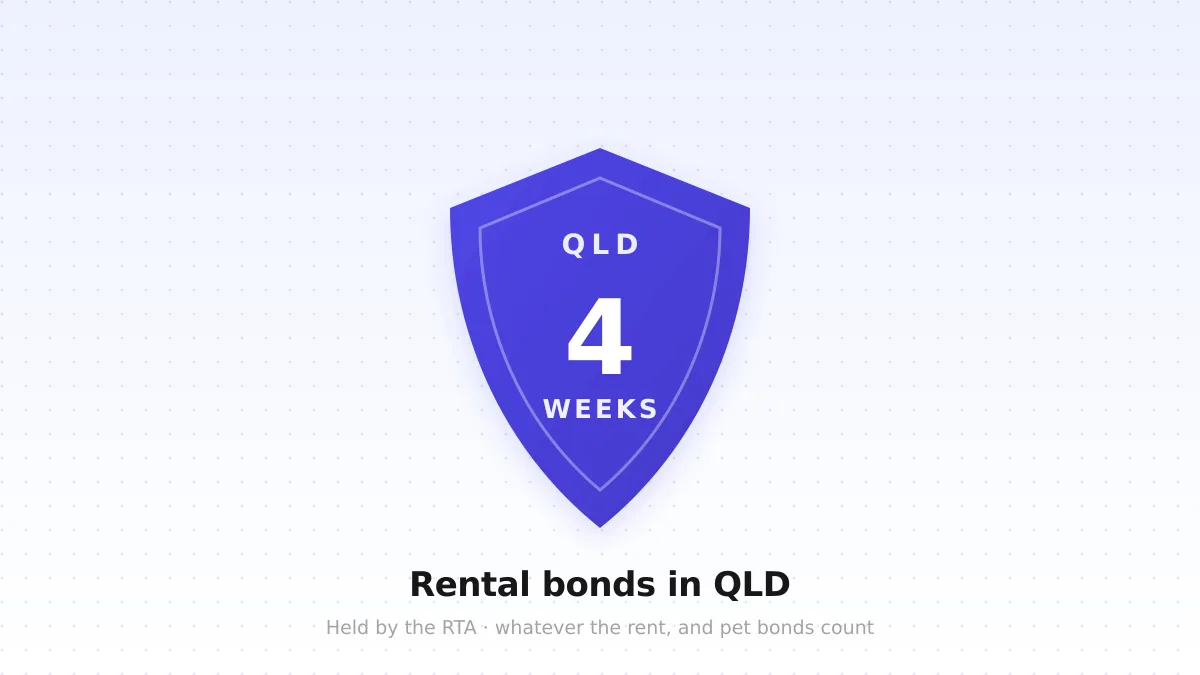
Queensland has the simplest bond rule in the country — four weeks’ rent, whatever the rent is — and one detail that surprises people: a pet bond is not extra. It comes out of the same four weeks.
Queensland’s bond rules are the easiest in Australia to remember, which is genuinely useful when you are comparing rooms across states.
The numbers
The maximum bond is four weeks’ rent. That applies to general tenancies and to rooming accommodation, and — unlike Victoria, South Australia and Western Australia — there is no higher-rent threshold that unlocks a bigger bond. Four weeks on $250 a week, four weeks on $1,000 a week.
Pet bonds are not additional
This one costs people money. The maximum in the Residential Tenancies and Rooming Accommodation Act 2008 applies to all bonds taken, whatever they are called and however many there are. So a "pet bond" is not a separate charge on top — it has to fit inside the same four-week cap. If you are asked for four weeks’ bond plus a pet bond, that is more than the law allows.
Who holds it
Bonds go to the Residential Tenancies Authority (RTA). If the property manager or owner takes a bond, they must give you a receipt and lodge it with the RTA within 10 days.
You can check your bond directly with the RTA. Do it — the receipt from your agent is a promise, the RTA record is the fact.
Which kind of renter are you?
Queensland splits share living into two regimes, and the one you are in changes your paperwork.
General tenancy
Everyone is named on the one agreement. You are all jointly responsible for the rent and the property, one bond covers the household, and moving somebody in or out means changing the bond record rather than settling up privately in cash.
Rooming accommodation
You rent a room and share the facilities, and you have your own agreement with the provider rather than a joint one with your housemates. Student accommodation, boarding houses and many by-the-room rentals fall here. The bond cap is still four weeks’ rent, and the provider still has 10 days to lodge it with the RTA.
Sub-letting from the person already living there
If your agreement is with the existing tenant rather than the owner, they are acting as your lessor. Ask two questions before you pay: is the head lease actually in their name, and has the owner agreed to the sublet? A sublet the owner has not approved can be ended in ways you have no control over.
Getting it back
Queensland uses an entry condition report at the start and an exit condition report at the end, and the gap between the two is what a bond claim is argued about. Fill in the entry report properly rather than signing it blank — note every mark, take photographs on the same day, and keep your copy.
At the end of the tenancy, whoever claims first sets the clock running, so do not leave it. If there is a dispute, the RTA offers free conciliation first, which resolves most cases without a hearing. What conciliation cannot settle goes to QCAT.
Where these numbers come from
Every figure on this page was read off the official source below on 15 August 2026. Tenancy rules change — sometimes more than once a year — so if you are about to hand over money, spend two minutes confirming against the original.
- Residential Tenancies Authority — Rental bond
- RTA — Rental bonds fact sheet (general tenancies)
- RTA — Rental bonds for rooming accommodation
This is general information to help you ask better questions, not legal advice. If something has already gone wrong, your state tenancy authority and your local tenants advice service will both help you for free.