

How to find a flatmate you’ll actually get along with
Most sharehouses don’t fall apart over rent. They fall apart over dishes, guests and noise at 11pm on a Tuesday. Here’s how to work out compatibility before you sign anything.
Ask anyone who has lived in a bad sharehouse what went wrong and you will almost never hear "they couldn't afford it". You will hear about the dishes. The partner who effectively moved in. The 2am kitchen conversations. The passive-aggressive note on the fridge.
Rent compatibility is easy to check and it is not what breaks households. Lifestyle compatibility is harder to check and it is what actually matters. The good news is that most of it can be established in a fifteen-minute conversation, if you ask the right questions.
Work out what you actually need first
Before you look at a single listing, be honest with yourself about three things. Not what sounds easygoing — what is true.
1. Your sleep and work rhythm
Do you get up at 6am? Do you work nights? Do you take calls from home all day? A hospitality worker who comes home at 1am and a teacher who is up at 6 can live together perfectly well — but only if both know that going in and the walls are thick enough.
2. Your idea of "clean"
Everyone thinks they are clean. "Clean" is not a category, it is a spectrum, and the useful question is specific: how long can a dish sit in the sink before it bothers you? An hour and "until the end of the day" are both reasonable answers, and two people at opposite ends of that will grate on each other within a month.
3. How social you want home to be
Some people want housemates who become friends — shared dinners, a couch to debrief on. Others want a pleasant, low-contact co-existence after a day of talking to people. Neither is wrong. Mismatching them makes one person feel rejected and the other feel crowded.
Questions that actually reveal something
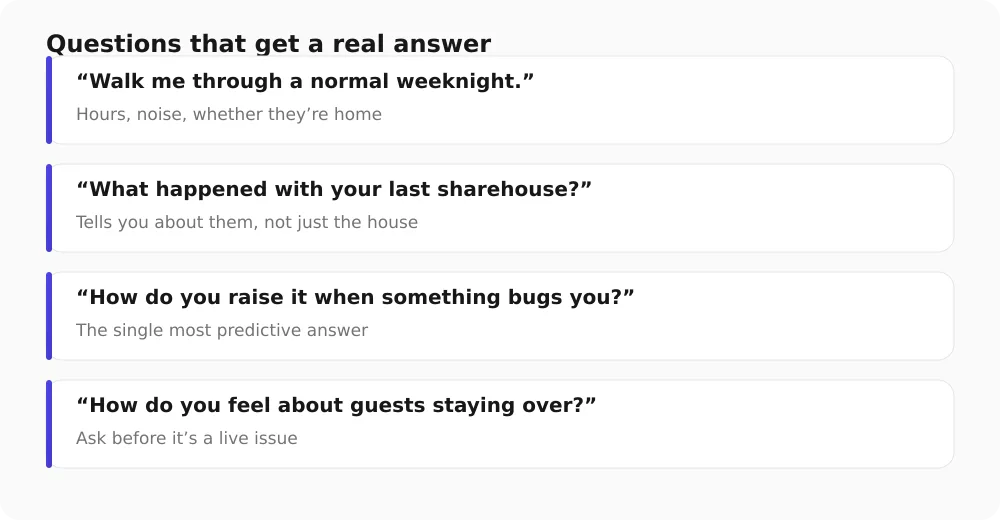
"Are you tidy?" gets you "yes" every time. These don't:
- "Walk me through a normal weeknight for you." Tells you their hours, their noise, whether they cook, whether they're home.
- "What happened with your last sharehouse?" How someone describes a past household tells you an enormous amount — about the household, and about them.
- "How do you feel about guests staying over?" Ask it before it's a live issue, not after.
- "When something's annoying you, how do you usually raise it?" The single most predictive question. Someone who says "I'd just mention it" will be easy to live with. Someone who says "I don't really, I just let it go" is describing a resentment that will surface in six months.
- "How do you want to split bills and shared stuff?" A five-minute conversation now, or a recurring argument later.
Meet in person, or at least on video
Text hides a lot. A ten-minute video call tells you more about whether you can share a kitchen with someone than fifty messages will — and it is also the single most effective anti-scam measure available to you. Anyone unwilling to appear on camera before taking your money is telling you something.
If you can, see the actual place with the actual people in it. Notice the kitchen. Notice whether the people who live there seem relaxed around each other.
Agree the boring things before you move in
Write these down somewhere everyone can see. Not as a contract — as a shared memory.
- Bills: whose name, split how, paid when
- Cleaning: a roster, or "everyone cleans up after themselves and we blitz the bathroom on Sundays" — either works, vagueness doesn't
- Guests: how many nights before a guest is a resident
- Shared food: communal staples vs strictly separate shelves
- Noise: a rough quiet-hours understanding
- Moving out: how much notice, and what happens to the bond
Households that discuss this in week one are dramatically less likely to blow up in month eight. It feels slightly awkward and it takes twenty minutes.
Red flags worth walking away from
- Pressure to decide or pay immediately
- Refusal to do a video call or an in-person viewing
- Vagueness about who is on the lease, or about the bond
- The current housemates seem tense with each other during the viewing
- Anyone speaking about a previous housemate with real contempt
The last one is underrated. You are hearing how they will describe you in a year.
Trust the meeting, not the profile
A good profile gets you to a conversation. It doesn't predict whether you'll be comfortable in your own kitchen. If the conversation feels like work, that's information — there will be other rooms, and the cost of choosing badly is a year of small daily friction.